
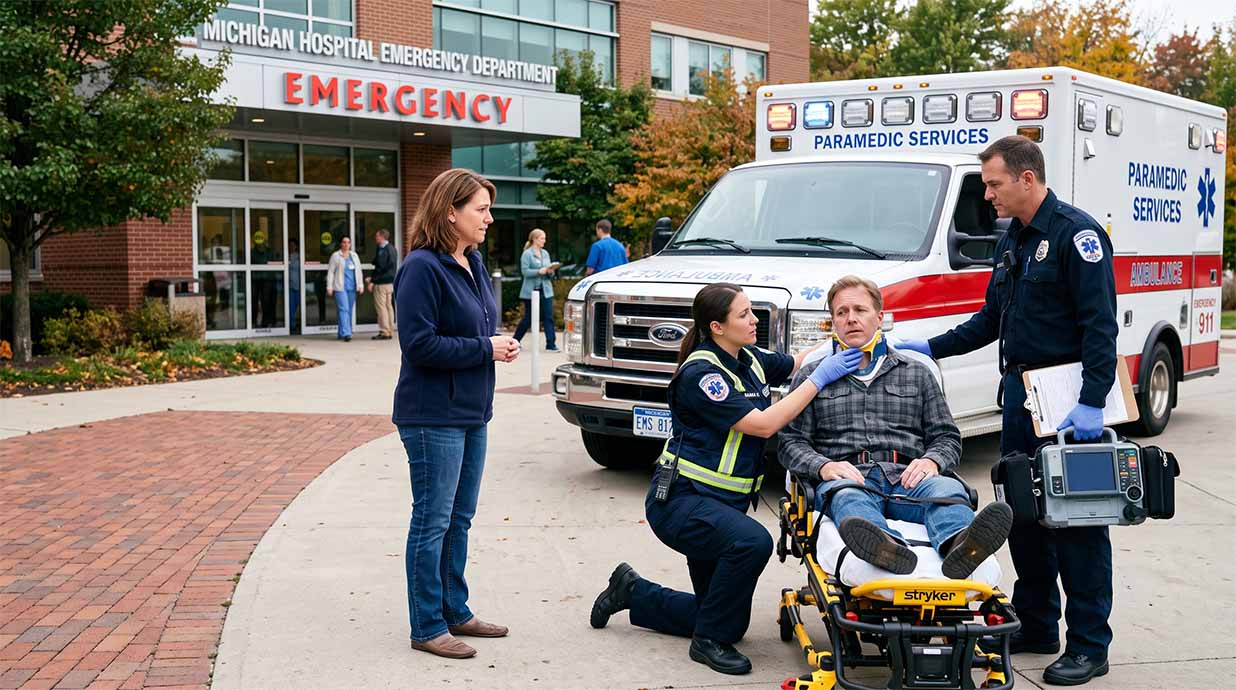
How to Recognize Brain Trauma Emergency Signs and Respond Safely
A traumatic brain injury can affect consciousness, speech, movement, behavior and breathing. Some warning signs appear immediately, while others develop over the hours or days after a blow or jolt to the head or body.
This guide explains which symptoms require emergency care and what you can safely do while help is on the way. It is written for patients, families and community members in Flint, Michigan.
Look for danger signs
Worsening headache, repeated vomiting, seizures, confusion, weakness or increasing drowsiness can signal a serious brain injury.
Protect the person
Keep them still, avoid unnecessary movement and watch their breathing and responsiveness until emergency medical services arrive.
Expect symptoms to change
A person may initially look well. New or worsening symptoms after a head injury still require prompt medical attention.
What Brain Trauma Symptoms Require Emergency Care?
After a bump, blow or jolt to the head or body, any of the following danger signs should be treated as a medical emergency.
Loss of consciousness or inability to wake
The person passes out, becomes increasingly drowsy or cannot be awakened normally.
Worsening headache
The headache becomes more severe, does not go away or is accompanied by neck pain or stiffness.
Repeated vomiting or a seizure
The person vomits more than once, has convulsions or experiences any type of seizure after the injury.
Confusion or unusual behavior
They cannot recognize people or places, become restless or agitated, repeat questions or behave unlike themselves.
Speech, movement or coordination changes
Slurred speech, weakness, numbness, reduced coordination or difficulty walking can indicate neurological injury.
Unequal pupils or vision changes
One pupil appears larger than the other, or the person reports new double vision or significant visual difficulty.
Blood or clear fluid from the nose or ears
Fluid drainage, bruising around the eyes or behind the ears, or a visible skull deformity needs emergency assessment.
Breathing or responsiveness changes
Abnormal breathing, declining responsiveness or a rapid change in the person’s condition requires immediate help.
Do not wait for several symptoms to appear. One danger sign after a possible head injury is enough to seek emergency help.
Call 911What Should You Do After a Suspected Serious Head Injury?
Your role is to call for help, prevent further injury and report what you observe. You do not need to diagnose the injury yourself.
Check responsiveness and breathing
Speak clearly and ask a simple question. Look for normal breathing and note whether the person responds appropriately. If they are not breathing normally, tell the 911 dispatcher and begin CPR if you are trained, following the dispatcher’s instructions.
Call 911 and explain what happened
Describe the injury, the person’s current condition and any danger signs. Mention a fall from height, vehicle collision, sports impact, assault, blood-thinning medication or alcohol and drug use if known.
Keep the head and neck still
Ask the person not to move and leave them in the position found unless the area is unsafe, you must provide CPR or the dispatcher directs you to move them. Do not remove a helmet unless CPR is required.
Watch for changes without performing tests
Continue watching breathing, responsiveness, speech and behavior. Note when symptoms began and whether they are worsening. Do not ask the person to walk, test their balance, count backward or complete memory drills.
Give responders a clear handoff
Tell emergency personnel what you saw, the time of the injury, any loss of consciousness, vomiting or seizure activity, and changes in the person’s condition.
- Provide the person’s medication list and known allergies.
- Mention blood thinners or a bleeding disorder immediately.
- Share relevant medical conditions and the injury mechanism.
What Should You Avoid When Brain Trauma Is Suspected?
These actions can worsen an injury, interfere with assessment or delay emergency treatment.
- Do not move or shake the person unless it is necessary for safety or CPR.
- Do not remove a helmet or an object embedded in a wound.
- Do not press directly on a suspected skull fracture or depression.
- Do not give food, drinks, alcohol or recreational drugs.
- Do not give medication unless emergency personnel advise it.
- Do not leave the person alone or allow them to return to activity.
- Do not shine a bright phone light into the eyes to test the pupils.
- Do not assume confusion or poor coordination is simply intoxication.
How Can You Support the Person While Waiting for EMS?
Keep them still and reassured
Encourage the person to remain in the position found. Keep them from becoming too hot or cold and speak calmly while monitoring their condition.
Follow dispatcher instructions
The 911 dispatcher may guide CPR, bleeding control or safe positioning. Follow those instructions instead of attempting an improvised assessment.
Protect a possible skull injury
If there is a deep wound, skull depression or embedded object, do not apply pressure or remove anything. Cover the area loosely with a clean dressing if available.
Respond to a seizure safely
Clear nearby hazards, protect the person from further injury and note how long the seizure lasts. Do not restrain them or place anything in their mouth.
Do not try to force an injured person to stay awake. Watch their breathing and responsiveness, and tell the dispatcher immediately if they become harder to wake or their condition changes.
Can Brain Trauma Symptoms Appear Later?
Yes. Symptoms can begin immediately or emerge over the following hours or days. Internal bleeding or swelling may not be obvious from the way a person looks after the injury.
Watch for new or worsening symptoms
- Headache, nausea, dizziness or balance problems
- Confusion, memory difficulty or unusual behavior
- Vision changes, weakness, numbness or poor coordination
- Changes in sleep, energy, mood or concentration
Follow the discharge plan
A clinician should decide how long observation is needed, whether the person may sleep normally and when they can return to work, school, driving, sport or other activity. Follow the instructions provided for that specific injury.
A concussion is a type of traumatic brain injury. It is not possible to reliably distinguish a concussion from a more serious injury at home. Seek emergency care if any danger sign develops.
Where Should You Seek Care for a Head Injury in Flint?
Suspected serious brain trauma belongs in an emergency department, not an urgent care clinic or routine office appointment. EMS can monitor the person during transport and select an appropriate emergency facility.
Call 911 for danger signs
Use ambulance transport for severe symptoms, declining responsiveness or a significant injury mechanism.
Go to an emergency department
Hospital teams can perform neurological assessment and arrange brain imaging or neurosurgical consultation when needed.
Arrange specialist follow-up
IGEN can help patients understand imaging findings, treatment options and the next stage of care after emergency evaluation.
Common Questions About Brain Trauma Emergency Signs
How quickly can brain trauma symptoms appear?
Symptoms may appear immediately or develop over several hours or days. A person who initially seems well can still develop signs of bleeding or swelling, so new or worsening symptoms need prompt medical attention.
Can someone with a serious brain injury appear normal at first?
Yes. Some injuries do not cause obvious symptoms straight away. Continue to follow medical advice after a head injury and seek emergency care if a danger sign develops.
What is the difference between a concussion and severe brain trauma?
A concussion is a form of traumatic brain injury that often causes temporary changes in thinking, balance, mood or physical symptoms. Severe brain trauma may involve bleeding, swelling or structural injury. Because symptoms can overlap and change, a healthcare professional should assess the injury.
Should suspected brain trauma go to urgent care or an emergency department?
Choose an emergency department when serious brain trauma is suspected. Call 911 for danger signs or a significant injury. An emergency department can arrange urgent imaging, monitoring and neurosurgical assessment if needed.
Is it dangerous to let someone sleep after a head injury?
Sleep itself is not the danger. Increasing drowsiness or difficulty waking can be an emergency sign. If a serious injury is suspected, call 911 and monitor breathing and responsiveness. After medical assessment, follow the clinician’s instructions about sleep and observation.
Clinical information sources
Guidance reviewed against the Centers for Disease Control and Prevention and the American Red Cross.
This page provides general educational information and does not replace emergency assessment, diagnosis or individualized medical advice.
Do You Need Help Understanding a Brain Injury Diagnosis?
Emergency symptoms require 911 and hospital care first. After the acute assessment, the Institute of General and Endovascular Neurosurgery can help you understand imaging findings, treatment recommendations and the next steps in care.